articles
Friendship: Lessons from a Puppy

If it’s possible to have a learning disability for friendships, then I’m pretty sure I have one. I marvel at the effortless way two young children can meet on a playground:
“Want to be my friend?”
“Uh-huh.”
“Okay. Let’s go play.”
And off they run — instantly bonded, instantly comfortable, and already introducing one another proudly as “my friend,” or even “my best friend.” Can it really be that simple?
I didn’t recognize my own “friendship deficit” until adolescence. As an only child with mostly solitary interests, I hadn’t realized anything was missing. My first real clue came in high school when two classmates decided to stop by. I knew how to answer the door; after that, the script dissolved. I led them to the living room and offered seats — because that’s what my mother did with her friends — and then we sat. And sat. And smiled politely. And sat some more.
Sometime during this silent ordeal, I learned the true meaning of anxiety.
Fortunately, my new puppy dashed in to greet them, finally giving us something — anything — to focus on. We giggled at his antics, but none of us knew what to do beyond that. Eventually they left. They never came back. And, to be honest, I was relieved. The whole encounter had been excruciating for everyone except the puppy.
In self-defense, I eventually learned how to “fake it.” I became so adept that I even fooled myself. In graduate school, during a class on the Myers-Briggs, my classmates were shocked that I scored as an introvert. Faking it allowed me to blend in, to appear comfortable, to come up with things to say… but it drained me. I’d return home exhausted and somehow less myself. 
Discovering that I was introverted — and that introversion could be a strength rather than a flaw — was the beginning of coming home to myself. I’d had a few meaningful friendships in my life, relationships in which I felt both connected and comfortable being fully me. I wanted more of those… but I had no idea how to find them. How does one make friends? Where do you meet them? What do friends even do?
The first thing I learned seems obvious now, but it eluded me for years:
If you feel drawn to someone, there’s a good chance — about 90% — that they feel drawn to you, too.
I’d had the equation reversed. If I liked someone, I assumed they were wonderful and would, at best, tolerate me. Given this belief and my finely tuned sense of self-protection, I spent years avoiding the very people I felt connected to. No wonder early friendships felt flat.
I still have to practice this, but now when I meet someone I genuinely like, I simply assume they like me too. The results have been far better than the alternative.
The second thing I learned is that my upbringing had left me thoroughly codependent. The infamous puppy afternoon probably failed because all three of us had been raised the same way — trained to be other-centered, constantly scanning for clues about who we were supposed to be. None of us knew how to simply be ourselves. The girls, as extroverts, found other friends. I, as an introvert, found another book.
Unlearning codependency has been an ongoing process. But during the moments when I’ve managed to stay connected to myself while also connecting with someone else, the experience has been incredibly rewarding. I’ve come to believe that we’re most appealing when we’re most genuinely ourselves. That kind of congruence is naturally attractive.
It certainly was for the puppy.
Oddly enough, the thing that helped me most was the rise of online friendships. Sitting at a keyboard, without all the in-person cues that once overwhelmed me, I could stay grounded. I could actually feel what the other person was saying and let it settle before responding. I joined an email group that grew increasingly close over the years. When we eventually began meeting in person, I confessed my “friendship issues,” and they lovingly decided to teach me the lost art of “hanging out.”
When I finally met one member in person, the entire group eagerly awaited her emailed report. Her subject line read: “Susan Hangs Out!” I felt like I had earned some kind of badge.
Looking back, I probably could have learned everything I needed about friendship from that puppy. When he wandered into the room that day, it never crossed his mind that we might not adore him. His own worth was a given — which freed him to focus on having a good time. He didn’t try to impress us. He didn’t contort himself into who he thought we wanted. He simply was, fully and joyfully.
Maybe puppies and young children share something we adults tend to lose — a blessed lack of self-consciousness. Of course, part of growing up means learning not to pee on someone’s foot or bite their hand, but beyond that, things seem to work best when we retain our original sense of ourselves: that steady inner knowing that we’re unique, that we matter, that we are lovable exactly as we are.
And herein lies the lesson from the puppy.
49 and I Ain’t Budging

Jacks, anyone?
When I was in my 30’s and early 40’s, I looked upon the issue of aging with a certain amount of reverent awe. I identified with the line from the John Denver song, “It turns me on to think of growing old,” and I viewed older people as being wise, at peace with the universe and having answers to questions that I longed to understand. However, in the 4+ years since my 45th birthday, I am experiencing an increasingly uneasy change of heart. My next birthday – the one that follows 49 – has become a dreaded occasion. I do NOT feel wise or at peace, nor do I have answers to most of the questions I had in my 30’s and early 40’s. Instead I feel an increasing variety of aches and pains and a most interesting (and growing) assortment of sags, bags, spots and lines. If this is all there is to aging, then my current answer to the whole experience is that I ain’t budging.
However, in fairness to the romantic idealism of my earlier years, it seemed that I should at least think through the whole thing a bit more before making a final decision to stay put. So as I all-too-rapidly approach the year that follows 49, I begrudgingly agreed to at least spend a bit of time reflecting on where I am and where I’ve been:
- I used to strive for perfection. It was such an intrinsic part of who I was that it never occurred to me to that it was something I could change – much less something that I might want to change. It simply “was”. Aging forces you to see things differently. It’s a little difficult to continue clinging to perfectionism as a way of life when you see yourself getting worse at some things instead of better. You’ve got to either put a different slant on things or spend larger and larger chunks of your time being depressed. Given those options, “different slant” starts to have definite appeal. As a result, my goal is no longer to be perfect, but rather to spend time getting to know and accept who I really am. An amazing outgrowth of this semi-forced experiment is that I’m beginning to see how my uniqueness (yes, maybe even a few of the sags, bags, spots and lines) offers something special that a more “perfected” version of me would never be able to.
- I used to think it was important to be liked . . . except for the period in my life when I fought against that concept so fiercely that I tried to “do my own thing” despite what others thought. I finally learned that when one’s “own thing” is defined as the opposite of what others would like, that it still isn’t really one’s “own thing”. After that minor revelation, I was able to actually settle down to the task of discovering what my “own thing” really was.
- I used to never get angry. Then I discovered my anger. Then I didn’t know what to do with my anger. Then I learned.
- I used to feel that everything was my fault. Now I just feel that most things are. Maybe in 49 more years . . .
- I used to find yard work overwhelming. I told myself that I preferred for my yard to have the “wild, natural look” that forests offer. All my neighbors probably referred to it as “that @#$%! weed patch” instead, but it was the best I could muster. This spring, I discovered the joy of planting flowers and fruit trees and I get great pleasure from watching them grow and just enjoying their presence. Of course, the birds, chipmunks, rabbits, insects, and raccoons eat the various edibles before they ripen, but maybe that’s not the most important thing.
- I used to be insulted when someone offered to help me carry something heavy to my car. Now I’m grateful.
- I used to think that I had to have the answers to the great questions of the world: Who am I? Why am I here? Who is God? Is there a God? What’s my purpose in life? etc. To settle for anything less than total and absolute Truth seemed like a cop-out. Now I’m content with simply knowing that some questions are beyond what we can fathom in this existence. Some questions, while perhaps not unanswerable, may currently be beyond our ability to answer and/or understand. That would not have been an acceptable answer to me 10 or 20 years ago. It is now.
I have a dear friend who’s been teaching me the fine art of having adventures. I’ve watched her struggle with some extremely difficult issues and manage to find fun in them while also accepting their darker realities. Through her I’m learning that sometimes one’s limitations are really just adventures in disguise – adventures waiting to be discovered – adventures that may lead us to new levels of understanding or perhaps just provide some good times along the way.
Wrinkles? Aches, pains and age spots? Decreasing abilities coupled with an increasing waist line? These are adventures?! Well, as I said, I’m 49, and I ain’t budging . . . . yet.
Bend in the River

The original “bend in the river”
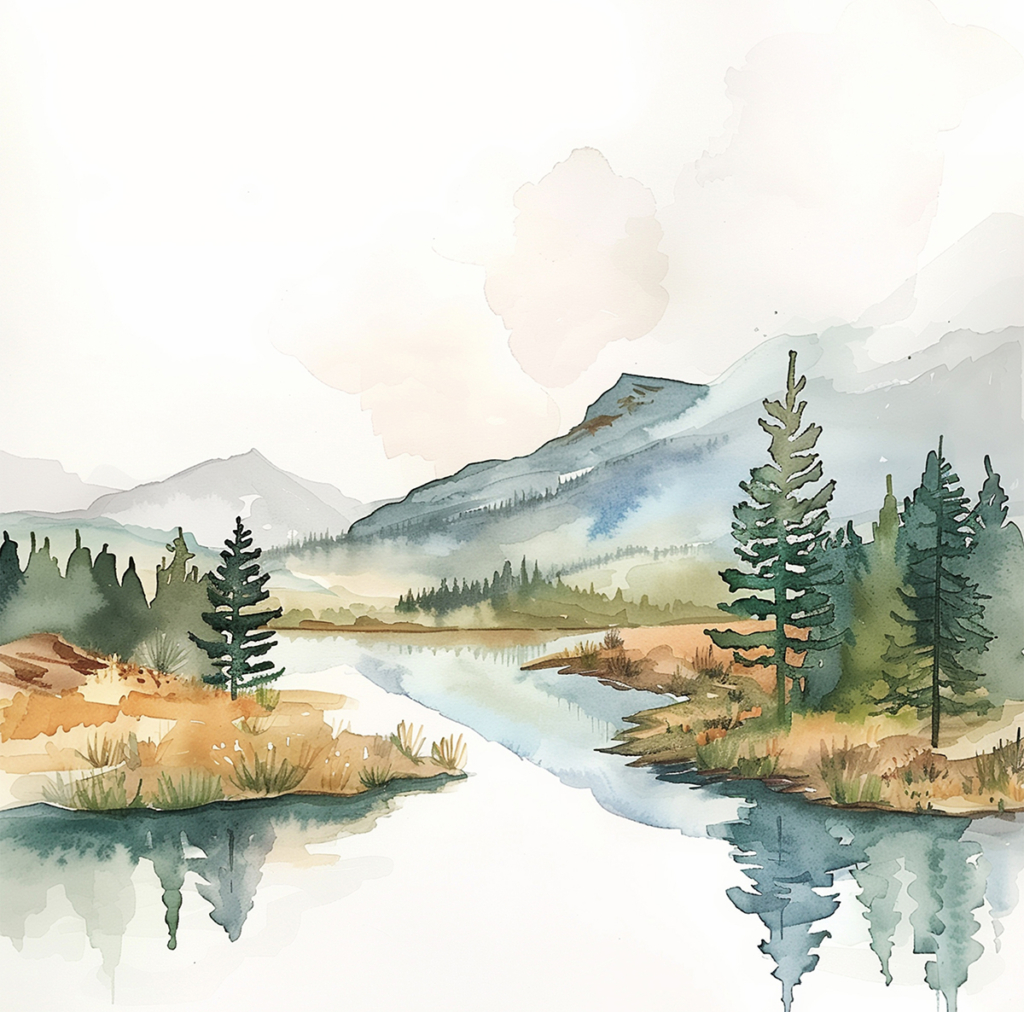
It’s now two days before the official beginning of the year that follows age 49 and I’m safely ensconced in a log cabin in the Smoky Mountains. I decided that if I can’t hide from the year that follows 49, I may as well find some way to celebrate it. I come to the mountains often, usually seeking a cabin on a ridge with a spectacular view or perhaps one close to town, making it easy to come and go for supplies. This time, it felt important to stay in a secluded cabin on a river, but I didn’t know why. On the drive up, it began to be clearer to me. As I drove, I felt a profound sense of both joy and peace. I’ve known these two emotions before, but somehow, this time they felt deeper, softer, rounder. The image that came to mind was that there was a river running through me — a river that was still and calm at the bottom. A river I could count on to get me through whatever life had in store for me, no matter how turbulent the waters might become on the surface.
I thought of river rocks — the smooth, round kind that you see in the Smokies. I’ve had a passion for them for years — again, without knowing why. But now it occurs to me that my aging process has been like those river rocks. My psyche no longer has quite so many of the rough, jagged edges that newer mountain ranges have — there are fewer obtrusions to tear at my soul as it journeys through life. There are still a few, and perhaps I’ll encounter others around some yet untraveled bend in the river, but there’s definitely a difference.
In our youth, when the rocks are still rough and craggy and when they loom enormous in comparison to our own size, they seem terrifying and/or intimidating. At that age, our best defense against them is avoidance, so most of us learn a variety of maneuvers designed to help us avoid the rocks or pretend they’re not there. As we reach adolescence and early adulthood, our fear gets replaced by bravura and we attempt to conquer the rocks — sometimes timidly, other times throwing ourselves into it with abandon. But it seems to me that as we age, we begin to take a whole new approach. We begin to see that rocks are to be neither feared nor conquered — rather, they’re things to interact with and learn from. Teachers disguised as rocks. They may still seem scary or exciting — at times they may still elicit an initial response of wanting to hide or to conquer. But there’s also a mellowing in our response. A willingness on our part to yield a bit and listen to what the rocks may be trying to tell us. An inner plasticity, not possible in our youth, which allows us to see the rocks as something to embrace as opposed to something to fear or to conquer.
My Birthday, for Better and for Worse
But that’s only part of the story. That’s the nice part — the part that makes turning 50 seem appealing. There’s another not-so-nice side of what this particular birthday has meant to me and that has to do with an acknowledgment of the losses. An acknowledgment of things I can no longer do, nor will I be able to do again. An acknowledgment of physical appearances that are forever changed, and continuing to change in a direction I’m less than thrilled about. An acknowledgment of people and places I may never see again.
But perhaps the most painful is an acknowledgment of things I’ve said or done that cannot be undone. A harsh word here, a partial truth there — things that came out of my own woundedness as a human being which caused me to behave in ways I’ve later regretted. Youth has a certain sense of denial about those kinds of things, I think. Whatever internal and/or external battles we’re in at the time seem to possess such epic proportions that we lose sight of the fact that the words and behaviors which stem from those battles leave permanent marks on our own lives as well as those of others. Marks which cannot be undone. Apologized for, perhaps. Learned from, hopefully. But not undone. A few years ago, my shame about this realization would have been so great that I wouldn’t have been able to look these shadowy specters square in the face. I’m still not sure I can, but I now have at least enough clearance down a sidelong glance that I can feel genuine regret.
Like most things, though, this particular cloud has a silver lining for aging also brings an increased ability to tolerate and forgive our shortcomings. Aging tends to provide the objectivity that enables us to look at ourselves with compassion in much the same way we might view a friend in similar circumstances. Surprisingly, the increased self-acceptance has also meant that I don’t say or do nearly as many things that I later regret. One of life’s great ironies is that the more we genuinely forgive and accept ourselves, the less we behave in ways that need forgiving.
There’s an additional wonderfully delicious offshoot to all of this. If I no longer have to be perfect and also, if I genuinely can and do forgive myself for times when I’m not, it frees me up to risk more — to dance with passion and abandon even when I don’t know the steps; to paint bolder and sing louder, even when the colors clash and the melodies are off key.
The Transition
Two days ago, when we first arrived at the cabin, I walked down to the river and picked up some river rocks — no particular number or kind, just the ones that spoke to me. As it turned out, there were 4 — one larger and 3 smaller. The larger one was a delightful old thing — just the right size and shape to fit in the palm of my hand when I picked it up. Today, following some inner urge, I assembled the 3 smaller rocks, walked down to the river, placed the rocks safely on the shore, removed my shoes, then waded to the center of the river and sat down. The clear, cold water swirling around me wasn’t high enough to suit me, so I scooped up handfuls of water and poured it over me. Finally satisfied, I began reaching through the water and picking up rocks around me — skipping some across the top of the water, putting others back where I found them, and arranging a few select ones on a larger, half-submerged rock nearby.
When I tired of this, I waded back to the shore to retrieve the 3 rocks I had brought with me from the cabin. I had known from the outset that they would need to be returned to the river before we left. As I picked them up and headed back out to my spot in the middle of the river, I wondered whether I had absentmindedly chosen 3 additional rocks to place on the half-submerged rock in the center. This afternoon’s experience with the river, which seemed to be some kind of mysterious culmination of the entire weekend, had been so strongly driven by my unconscious, that it seemed likely. I was a little disappointed when I got back to the middle and saw that there were 4 rocks there, not 3. It made me doubt. Doubt me? My unconscious? The universe? My ability to be guided by my unconscious/the universe? Before I could figure it out, I was struck by what I saw — what had actually happened. For on the large, half-submerged river rock, there were now 7 smaller rocks — the 3 original ones, and 4 newer ones. Seven. For years, I’ve known that both the numbers 3 and 7 were important in my life. I’ve had dozens of mysterious, yet compelling dreams with one or both of those numbers in them. So what I had unconsciously chosen were “3” original rocks, then enough more to make “7.” It was complete.
I sat in the middle of the river for a long time — allowing myself whatever time I needed before returning the rocks. From this vantage point, the downstream portion of the river veered off to the left making it impossible to see what course it followed beyond the bend. I especially loved looking in this direction, and had no need to know what lay ahead. There was a heavy resignation about relinquishing the rocks. One of the original 3 rocks was flat and perfectly round. I was very attached to it in a way I didn’t understand and my heart ached to think of letting it go. When the time came to throw the rocks back into the river, tears ran down my cheeks despite the fact that I had no inkling about the meaning of this ritual. I washed my face in the river water and did not need to understand — the process was what had been important.
At one point, my perspective suddenly shifted and instead of being caught up in my internal feelings and symbols, I saw myself as an outsider would have — a 50-year old woman, sitting in the middle of a river in mid-December, clad in sweats and socks, alternating between pouring water on herself and examining or throwing river rocks. I laughed heartily and was relieved to realize that whatever had been relinquished that day, it had not been my sense of humor and ability to laugh at myself.
A Final Note
I have no idea what I did out there today. I probably never will. I never have known the significance of the numbers 7 or 3 and this experience didn’t bring me any closer to that understanding. I do know, however, that something important happened during that experience in the river. Something that changed some fundamental aspects of me which will remain forever changed. Something that made being 50 a little more OK. Perhaps I let go of certain events or feelings from the past. Perhaps I let go of ways of being that no longer serve me. Or perhaps it wasn’t really about letting go at all, but rather more about a willingness to let go even when I don’t know what it is that’s being relinquished. To be lead by faith even when I neither understand the present nor have a sense of the future.
So as I sit here on my birthday, still feeling like the label of 50 doesn’t quite belong to me, I wonder what my decision would be if I had been given the choice about aging — if by some magic stroke, I could choose to stay young forever, with all it’s pros and cons. My answer is that it depends. If it were possible to have smoother rocks on a newer mountain range, then yes, I would choose that. But as long as it’s an either-or choice, I’ll choose to keep moving along, allowing myself to be gently pulled and guided by the next bend in the river.
Losing Weight: A Good Thing?
With our obsession on thinness, most of us have rather predictable times when we begin to think of losing weight. We start new diets as part of our New Year’s resolutions, in preparation for weddings, class reunions and hot dates, before swimsuit weather, or when our clothes start feeling tight or the number on the scales gets too scary and depressing. Once we’re triggered into dieting mode, most of us jump headlong into our favorite scheme for weight loss without taking the time to think it through. We do this despite the fact that we know the statistics for losing weight and keeping it off are gloomy at best. The reality is that most of us fail in our weight loss attempts and yet we keep doing it over and over again.
I think that the primary reason for our failure is that we’re skipping a step. Instead of plunging headlong into dieting, we should take time to ask ourselves if this is really a good time for us to undertake a weight loss program. If, after some excruciatingly honest soul-searching, the answer to this question is yes, then choosing a method is relatively easy. Many people sabotage themselves by asserting that the time is right when it’s really not. Such diets are doomed from the outset. Though seemingly innocent, these ill-advised attempts can result in health problems, eating disorders, additional weight gain and at the very least, severe blows to one’s self-esteem when the plan fails.
Should I?
the objective part of the question
The ‘should I’ question is actually a group of questions, which can be broken down into two parts: objective and subjective. The main objective question concerns your physical health. Would your physician agree that it’s in your best interest to lose weight? If not, then your goal should not be to lose weight, but rather to concentrate on learning to accept your body as it is. For most of us, the goal of self-acceptance is much harder to achieve than weight loss — which is why we tend to delude ourselves into thinking that our physician must somehow be wrong if they tell us that our weight is fine.
Many of us have developed the sense that there’s something inherently wrong with us as we are. We’re not really sure why, but we’re convinced that it’s true. In this uneasy state of believing we’re bad or defective yet not knowing why, weight is a natural thing to pin the problem on. Everywhere we look, we find confirmation for the idea that fat is synonymous with bad. Since weight is readily measurable in the privacy of our own homes, we have instant, daily access to an amazing little meter on the floor that can tell us whether we’re “good” or “bad.” Most people who think they want to lose weight are primarily trying to find ways to feel better about themselves and have become deluded into thinking that weight loss is the answer. The cycle, most of which is typically unconscious, is:
- Something causes our feelings of self-worth to reach an intolerably low level.
- Rather than challenge the assumption, we accept it as true and attempt to figure out why we’re so worthless.
- We decide that the answer must be that we’re too fat, so we set out to try to lose weight.
One of the many problems with this seemingly attainable fix is that it doesn’t work. Even if we succeed in our weight loss scheme and reach the magic number we set for ourselves, we end up with a thinner body but we also still have what we started out with: a sort of amorphous sense that there’s something wrong with us. It’s at this point that eating disorders begin, people gain back the weight they lost and/or other symptoms such as depression, anxiety, suicidality and obsessive-compulsive tendencies develop. These additional symptoms typically leave us feeling even worse about ourselves and often put our health at risk as well. The effects of yo-yo dieting and/or eating disorders are much more serious health risks than being overweight. So if your physician wouldn’t agree with you that losing weight is in your best interest, please consider working on changing your self-image instead. Even though it’s a much more difficult goal to attain than weight loss, in the long run you’ll be happier and healthier with that solution.
the subjective part of the question
For those of you whose doctors agree that it would be healthy or at least not harmful for you to lose some weight, what next? Spend however much time is necessary — days, weeks, months — determining what your likelihood for successful weight loss is at this particular time in your life. If you discover that you’re not likely to succeed, change your focus. Instead of dieting, do other kinds of things that make you feel good about yourself and that are nurturing. Find ways to boost your self-esteem in non food- or weight-related ways. You’ll feel better about yourself now, and you’ll also be setting the stage for any possible future weight loss attempts. Instead of being critical of yourself because you’re not in a place to lose weight, pat yourself on the back for your self-awareness and honesty. If your goals are truly to lose weight and keep it off without damaging your self-esteem and your health, you’ll be happier if you wait until the time is right.
Below are several examples of situations that might mean it’s not a good idea (or a good time) to begin a weight loss program. These are only meant to stimulate your thinking, though. There’s an infinite number of possible reasons and what’s important is to discover what’s true for you.
- Having weight and self-esteem overly linked in your mind. Ironically, one thing that will sabotage a weight loss program more quickly than most anything else is if we’re doing it because we think there’s something morally wrong with being fat. Actually, the part of us that sabotages this type of diet is usually a very healthy part of us. That part is basically saying, “Hey! What makes you think you need to lose weight to be an okay person? There’s nothing wrong with you. You’re basically pretty neat. Why don’t you work on getting that first, and then we’ll talk about losing weight?” Even when the reasons for beginning a weight loss program are for health reasons, the diet will be much more likely to succeed and be much more enjoyable if it’s coming from an “I want to do this” place, as opposed to an “I should” place.
- When food is your main (or only) source of nurturance. We all need nurturance. It’s a proven human need. If food is your only source of comfort, please don’t deprive yourself by taking it away. Instead, it might be more helpful (and respectful) to begin some self-examination to discover what other things you might be able to derive pleasure and comfort from and begin cultivating those. Once you have other ways of being nurtured, food won’t seem as important and you’ll be able to lose weight without feeling so deprived.
- When there’s a sense (often unconscious) of needing extra weight as protection. Some people have a sense of needing extra protection around them. The world can seem like a scary place without some additional “armoring”. If this is true for you it’s much more self-respectful to work on finding other ways of feeling safe before you begin a weight loss program. The unconscious need to feel safe is extremely powerful and will almost assuredly sabotage any weight loss program you try until the need is satisfied in other ways.
- When eating and/or weight is symbolic for something that’s not resolved in your life. Food and weight can be symbolic for almost anything – someone or something from our past that we strongly identified with in either a negative or positive way. Sometimes these internal symbols are convoluted and difficult to understand, but at other times, they’re fairly straightforward. A straightforward example of a positive symbol might occur if your idolized 4th grade teacher happened to be fat, then you may have unconsciously associated “fat” with “cool person”. The result might be that now when you try to lose weight, your unconscious says, “But WAIT! If you lose weight, you won’t be a cool person!” And of course, if you, on the more conscious end of the spectrum are telling yourself, “I won’t be cool UNLESS I lose weight,” it’s a setup that’s not only bound to fail, but also will likely produce an incredible amount of anxiety along the way. A similar example of a negative symbol would be if someone who once hurt you was thin, you might associate “thin” with “bad” or “dangerous,” which could cause your unconscious to want to avoid being thin, resulting in a similar battle. Personal symbols are usually incredibly powerful. Unfortunately, they are also often difficult to unravel. If you think a symbolic meaning for food or weight may be prohibiting you from losing weight, working with your dreams and/or other methods for exploring the unconscious may help.
- When you’re going to visit Aunt Mary (or her equivalent). All of us have an “Aunt Mary.” You know — that person (restaurant, vacation resort, etc.) who prepares the most totally irresistible goodies you can imagine. So if you’re going to have Sunday dinner with Aunt Mary, start your weight loss plan after your visit, not before. Going to stay for a week or a month? Wait until you get back to begin. Going to move in with Aunt Mary? A bit more of a problem! At least let the novelty of all those goodies wear off for a few weeks before you consider whether or not you want to lose weight. Even the most scrumptious things lose some of their appeal after a few weeks of unmitigated self-indulgence.
- When we’re under unusual amounts of pressure and/or stress. Follow the same guidelines as for Aunt Mary. If the stressful situation is chronic, it would probably be a good idea to learn some techniques for dealing with stress (and/or your particular situation) before attempting a weight loss program.
- When our primary support system attempts to sabotage our weight loss efforts. Spouses and other family members sometimes have an unconscious need for us to keep our extra pounds. Sometimes a simple explanation and pointing out to a well-meaning spouse that the things they do are creating difficulties is all it takes to remedy the situation. But if a family member really needs to remain fat, they will most likely unwittingly continue to sabotage, even if they’re trying hard not to. The important things to consider are 1) that you can’t change them and 2) given how they are, will you be able to find other ways to support yourself and feel good about yourself as you lose weight, no matter how they react? Sometimes it helps to have game plans in mind for possible ways they may try to sabotage. What will you do if they bring your favorite food home? What if they want to take you to your favorite restaurant? What if they make critical comments about you while you’re dieting? What if they lose interest and seem to pull away from you? It’s not impossible to lose weight if your family is non-supportive, but it definitely makes it harder, so it’s best to plan for it ahead of time.
- When we plain don’t want to. This last reason may well be the most important of all. Unless there are serious health reasons behind your desire to lose weight, to choose not to diet just because you don’t want to has always struck me as being very healthy. We really don’t all need to look alike or weigh the same amount, no matter what the fashion magazines seem to imply. So if your heart isn’t in the idea of losing weight and if it’s not a medical emergency, then applaud yourself for being able to resist societal pressures, and focus on enjoying life at your present weight.
how to lose weight
Everyone knows that losing weight requires a decrease in caloric intake, an increase in exercise or some combination of both. There’s an almost infinite number of varieties of this basic formula, and all of them work. The important thing then, is to choose one that will be the easiest for you to stick with. Some people prefer calorie counting, others prefer more general plans such as eliminating sweets, cutting back on fats, not snacking between meals, etc. Some people work best alone, others do well with the structure and support of a group or professional weight loss center or exercise program. Some prefer to use pre-packed items, while others want to continue choosing their own foods. Some don’t want to alter their food intake at all, but prefer to simply increase their exercise level. Some people want a combination of diet and exercise. To figure out what will work best for you, think of questions like: Which one will I enjoy more? Which one fits my budget? Which one will be easiest for me to stick with? Which one fits my personal/professional lifestyle and schedule? Ideally, whatever you come up with should be nutritionally balanced. If you feel that your weight loss plan may not be, supplement it with a multipurpose vitamin/mineral combination. It’s always best if we get adequate nutrition in the foods we eat, but this is sometimes difficult if we’re also trying to lose weight.
One very important thing to consider when trying to decide on the food plan you want is that if your goal is truly to lose weight and keep it off, research has shown that the best way to accomplish this is through slow, gradual weight loss. Quicker, faddish types of schemes may take weight off faster, but it’s also more likely to come back.
stickability
If you find you have trouble sticking with your weight loss plan, instead of being critical of yourself, it’s time to play detective to figure out what’s going wrong. A place to start is to go back to the “Should I?” questions again. Are you trying to force your body to achieve and maintain a weight that’s too low? Are there some unconscious reasons for not losing weight that are causing you to sabotage yourself? Has something in your life changed since you began your diet so that even though it was a good idea at the time, it’s too much right now? If the answer to these types of questions is no, then look at your weight loss plan. Do you need to alter it in some way? Maybe you’ve discovered that your bedtime snack is really important to you, so you’d rather have a smaller dinner and keep your bedtime snack. Maybe your plan was fine in the beginning, but you’ve become bored with it and a different one would be better now. Maybe there’s nothing wrong with your plan, but you just need a day (or week) off. Maybe you’re trying to lose weight too quickly. Maybe you need to stop weighing yourself. The list is endless. Again, what’s important is to discover what’s causing your own difficulty and then problem-solve ways to deal with it. To have trouble along the way does not mean you’ve failed; instead, think of it as an opportunity to learn more about yourself.
a final note
If there’s one thing that’s more important to losing weight than anything else, it’s liking yourself. This is important in the pre-diet planning stage, the diet stage, and the maintenance stage. Since it’s a key feature at all three stages, I think it’s usually better to work on accepting, respecting, and liking yourself first, and then see if you still want to lose weight. If you can’t accept yourself at your current weight, chances are you won’t be able to at your goal weight, either. And when your entire sense of self-worth no longer resides in what the scales or mirrors say, losing weight (or deciding not to) becomes so much less difficult and tedious.